

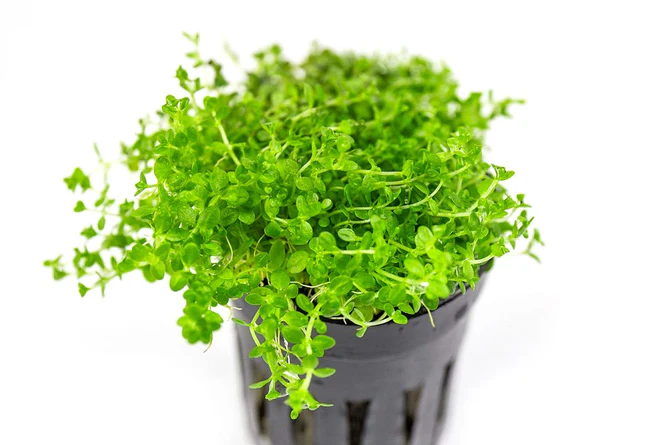
Description
Dwarf Baby Tears 2″ pot
Dwarf Baby Tears care
Dwarf Baby Tears (Hemianthus callitrichoides) care guide
Dwarf Baby Tears (HC Cuba) are a beautiful and popular carpeting plant in planted aquariums, but they require a certain level of dedication and specific care to flourish.
Here’s what you need to provide for a thriving Dwarf Baby Tears carpet:
1. Lighting
- Medium to High Intensity: Dwarf Baby Tears are photophilic and need bright, direct light to grow horizontally and compact, forming a dense carpet.
- Duration: Aim for 10-12 hours of direct light per day.
- Consider PAR: 40-50 PAR of LED lighting is a healthy target Note that the depth of the tank impacts the light intensity reaching the plants.
- Low Light Effects: Insufficient light will cause the stems to stretch upwards and become sparse, instead of carpeting.
2. CO2 injection
- Essential for carpeting: While they can technically survive without it, CO2 injection is highly recommended for Dwarf Baby Tears to thrive and form a lush, dense carpet.
- Dosage: Aim for a steady injection of 10-30 mg/l of CO2.
- CO2 Deficiency: Stems growing upwards and smaller leaves can be signs of CO2 deficiency.
3. Substrate
- Nutrient-Rich: Dwarf Baby Tears have short, delicate roots and benefit greatly from a fine-grained, nutrient-rich substrate like ADA Amazonia aqua soil or Aqua Soil Powder.
- Depth: A substrate depth of 1.5-2 inches is ideal for the roots to take hold.
- Planting: Plant the stems deep enough to be anchored, but ensure the top part of the plant is not smothered by the substrate.
- Anchoring: If the plants have trouble staying rooted, gently wedge them back into the substrate or consider using fine gravel or aquasoil to improve anchorage.
4. Water parameters
- Temperature: Maintain a stable temperature between 68-75°F (20-24°C).
- pH: Optimal pH range is between 6.0 and 7.5.
- Hardness: Appreciates a water hardness level between 1 and 10 dGH (soft to moderately hard water).
- Consistency: Avoid sudden changes in water parameters, as this can cause Dwarf Baby Tears to “melt” (lose color and become translucent).
- Regular Maintenance: Perform regular water changes and monitor water parameters with test kits.
5. Fertilization
- Liquid Fertilizers: While the substrate provides some nutrients, liquid fertilizers may be necessary, especially if you notice leaves becoming yellow or losing density.
- Iron Supplements: Dwarf Baby Tears are susceptible to iron deficiencies, which can cause yellow shoots.
6. Trimming
- Regular Trimming: Essential for maintaining a dense carpet and preventing the lower parts from dying off due to lack of light.
- How to Trim: Use sharp aquascaping scissors to trim the top parts of the plant, leaving a few centimeters above the substrate.
- Avoid Up-rooting: Be gentle during trimming to avoid disturbing the delicate root system.
7. Propagation
- Runners: Dwarf Baby Tears naturally spread through runners, horizontal stems that send out new roots and shoots.
- Stem Cuttings: You can also propagate by taking stem cuttings from mature plants and replanting them in the substrate.
8. Aquarium mates and compatibility
- Peaceful Fish: Platies, tetras, danios, and rasboras are generally compatible.
- Freshwater Shrimp: Shrimp can be beneficial as they consume biofilm and algae without harming the plants.
- Avoid: African cichlids, goldfish, barbs, rabbit snails, apple snails, crayfish, and crabs can be harmful to Dwarf Baby Tears.
9. Common problems
- Melting: A common issue during the transition from emersed to submerged growth or due to sudden changes in water parameters.
- Yellowing/White Coloration: Can be caused by iron deficiency or insufficient light reaching the base of the plant.
- Floating Plants: May occur if the roots aren’t properly anchored or the substrate is too coarse.
- Algae Growth: Dwarf Baby Tears are slow growers, and high light and nutrients can promote algae growth, potentially outcompeting the plant.
Reviews
There are no reviews yet.